


Behavior Driven Development (BDD): From Theory to Working Implementation
 12 MIN
 11 Sep 2025
Behavior Driven Development helps testers and teams turn fuzzy ideas into crystal-clear, testable behaviors. It starts with natural language and ends in reliable, automated tests everyone understands. If you’re new to BDD, it can feel simple in theory but tricky to apply in real life.
Table of content
Behavior Driven Development (BDD) isn’t just a buzzword – it’s a practical approach that helps QA teams work with clarity and confidence. Speed matters, but shared understanding keeps teams moving. BDD turns vague requirements into concrete, testable behaviors that everyone – from developers to business stakeholders – can grasp.
Its strength is simplicity: a few lines of plain language define feature behavior, serving as living documentation, automated tests, and a source of truth that evolves with your product.
The challenge is putting it into practice. Many teams get stuck between “we should write scenarios” and actually using them to drive development. This guide walks you through the full behaviour-driven development lifecycle with real examples and proven techniques for making it work.
What is behaviour driven development?
Imagine if testing software wasn’t about constantly chasing ever-changing requirements, struggling with unclear specifications, or playing detective to figure out what the product is “supposed” to do. Instead, imagine having a shared language that connects developers, testers, and business stakeholders — a clear way to describe how the system should behave so that everyone can understand it. That’s exactly the promise of behaviour driven development testing, a collaborative approach that turns vague requirements into concrete, testable scenarios.
That’s exactly where Behavior Driven Development (BDD) comes in.
BDD is a mindset and a collaborative approach that encourages teams to focus on the behavior of the application rather than just the technical implementation.
The core idea and specifications of BDD
At its core, BDD is about defining how software should behave through conversations, examples, and collaboration — before a single line of test code is written. It builds on the principles of Test Driven Development (TDD) but shifts the focus from “how do we test this code?” to “how should the product behave from the user’s perspective?”
Instead of writing isolated unit tests for individual functions with little context, BDD encourages teams to:
- Collaborate closely to understand requirements from a real-world perspective
- Define concrete scenarios that the application must handle
- Use these scenarios as a guide for development, testing, and acceptance
These scenarios don’t just help during development — they become living documentation. They provide a reference point that:
- Guides developers while writing code
- Serves as acceptance criteria for testers
- Continues to be valuable long after the product is released
By focusing on behavior, BDD helps create software that meets the real needs of users while improving communication and reducing wasted effort across the team.
Why teams benefit from behavior-driven development
BDD brings clear advantages for the entire team. By integrating BDD into your workflow, teams can avoid common pitfalls and work more efficiently together. Here’s how:
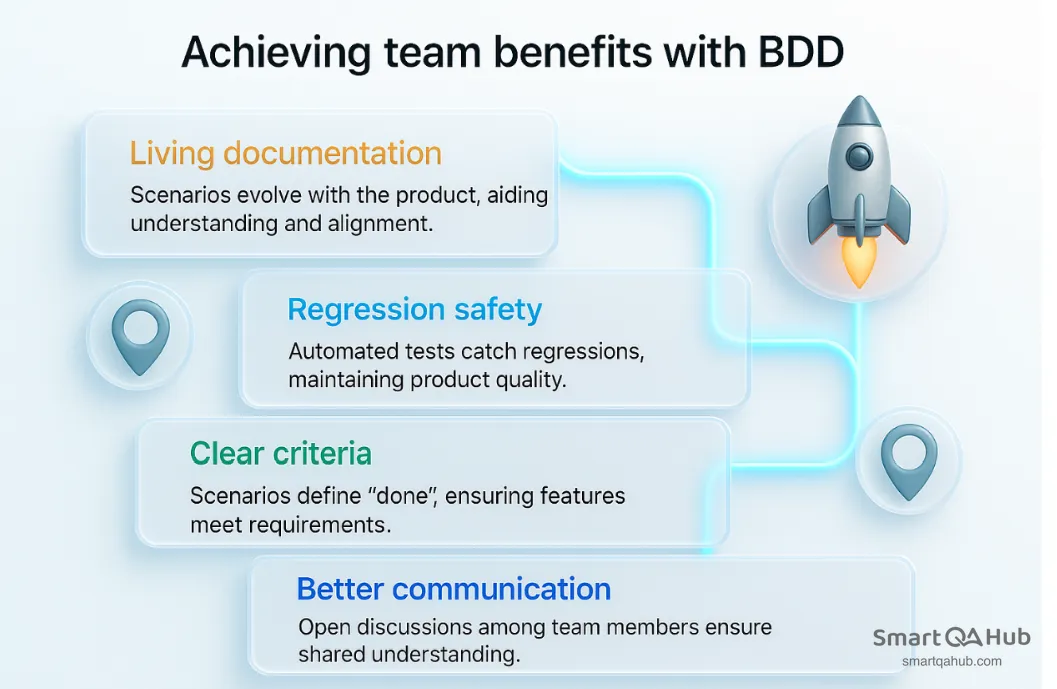
- Better communication and shared understanding – Scenarios are discussed openly with developers, QA testers, and business stakeholders, reducing misunderstandings and ensuring everyone is on the same page.
- Earlier feedback and issue detection – By defining behavior before any code is written, potential problems can be identified early, saving time and effort downstream.
- Clear acceptance criteria – Scenarios act as precise definitions of “done,” so the team knows exactly when a feature meets requirements.
- Continuous regression safety – These scenarios can double as automated tests, helping teams catch regressions quickly and confidently as the product evolves.
- Living documentation – The scenarios provide a single source of truth that grows with the product, making it easier for new team members to understand the system and for the team to maintain alignment over time.
Overall, BDD helps teams collaborate more effectively, reduce rework, and deliver higher-quality software faster.
BDD and agile framework
BDD is widely adopted in Agile environments because it aligns perfectly with Agile principles such as iterative delivery, continuous feedback, and close collaboration. Agile teams work in short cycles, aiming to deliver small increments of business value while constantly adjusting based on feedback. BDD supports this by providing a clear, shared understanding of how each feature should behave before development begins. By writing scenarios in plain language, BDD ensures that developers, testers, and business stakeholders all see the same expectations, reducing miscommunication and helping teams deliver working software that truly meets user needs. In this way, BDD acts as a bridge between Agile’s flexible processes and the need for precise, testable requirements.
The Language of BDD: Gherkin
One of the key strengths of BDD is its clear, structured language, which makes scenarios readable by anyone on the team, regardless of technical skill. This language is called Gherkin, and it follows a simple, consistent format that bridges communication between developers, testers, and business stakeholders. A classic behaviour driven development example shows how a user story can be turned into a set of Given–When–Then scenarios that guide both development and testing.
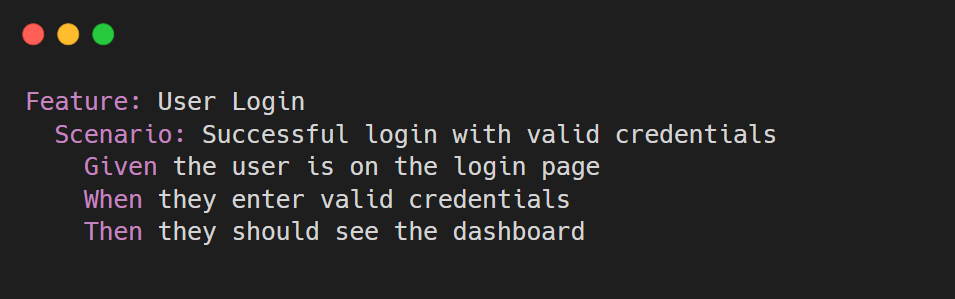
Here’s a basic example:
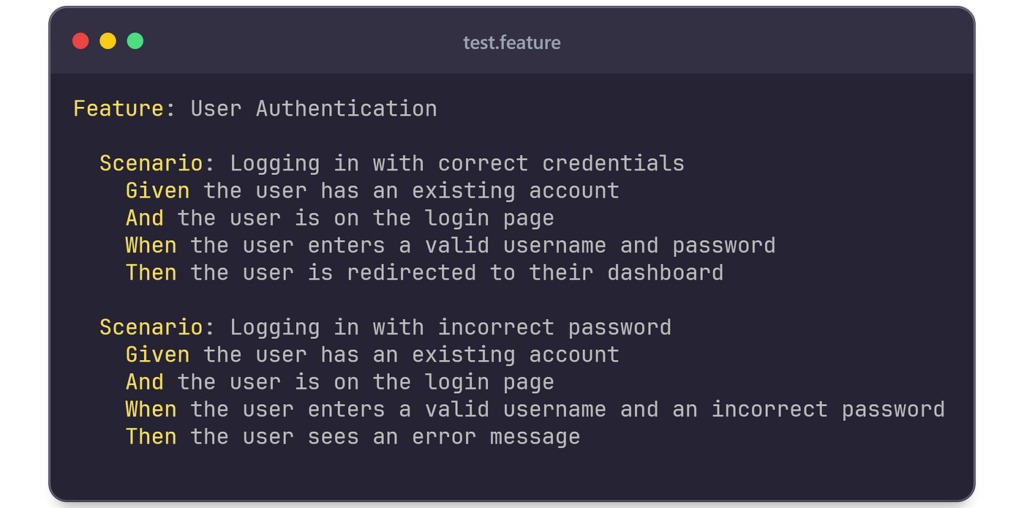
Source: https://miro.medium.com/
Let’s break it down:
- Feature – Represents a high-level functionality or behavior of the system. It describes what part of the application you are focusing on, like “User login” in this case.
- Scenario – A concrete example of how the feature should behave under specific conditions. Each scenario is like a story that explains what should happen in a particular situation.
- Given – Sets the initial context or preconditions. It describes the state of the system before any action is taken. For example, “Given I am on the login page” sets the stage for the scenario.
- When – Describes the action or event that triggers the behavior. In the example, it’s “When I enter a valid username and password.” This is the step that tests how the system reacts to a specific input or event.
- Then – Specifies the expected outcome or result. It answers the question: “What should happen if everything goes as planned?” Here, “Then I should see the dashboard” confirms the expected behavior.
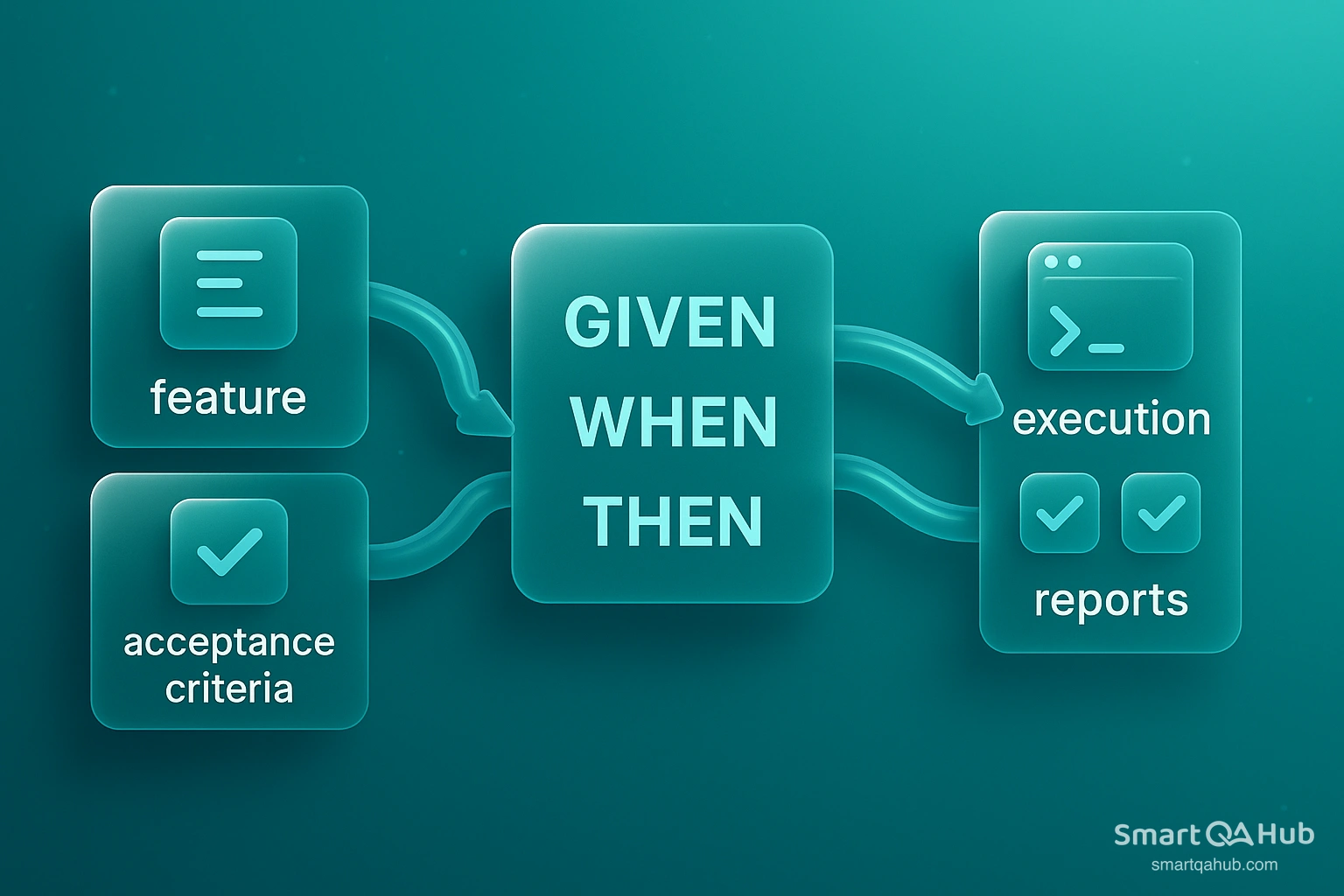
This style is known as Given–When–Then (GWT), and its biggest advantage is clarity. Everyone on the team — developers, testers, and business analysts — can read, understand, and contribute to these scenarios without writing a single line of code.
Additionally, Gherkin scenarios are reusable and maintainable. They can serve multiple purposes: as living documentation that evolves with the product, as acceptance criteria for software development, and as the foundation for automated tests, providing continuous feedback loop as your software changes.
By using Gherkin, teams create a shared language that eliminates ambiguity, improves collaboration, and ensures that everyone understands exactly what behavior the software should exhibit.
The BDD lifecycle: From discovery to delivery
Behavior Driven Development (BDD) is most effective when integrated throughout the development cycle, not just as an afterthought. By following a structured workflow, teams can ensure that features are well understood, implemented correctly, and continuously validated. This is the essence of BDD behaviour driven development, helping teams turn clear software requirements into executable, automated tests. Here’s how it typically works:
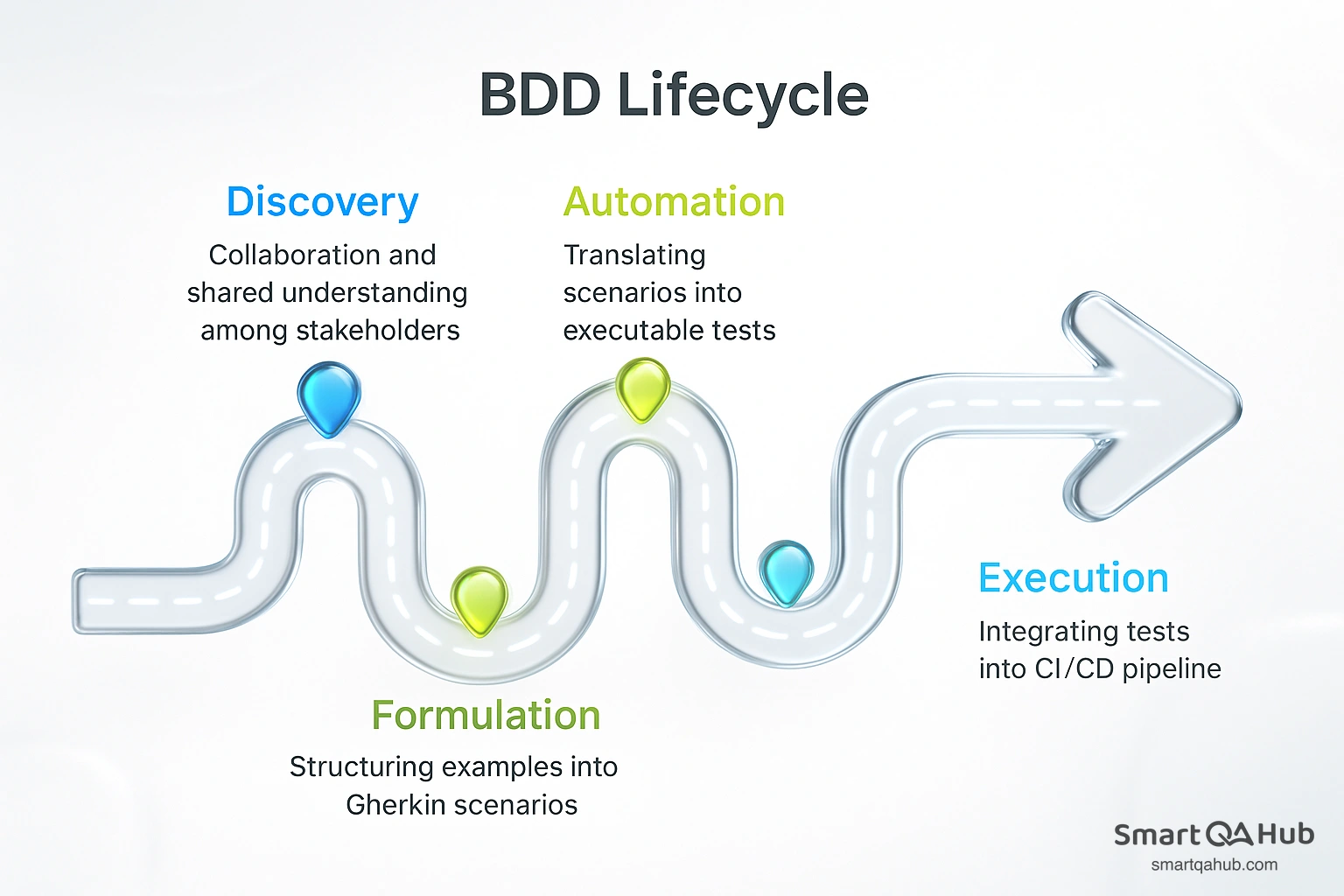
1. Discovery: Three amigos
The first step is all about collaboration and shared understanding. Often called the “Three Amigos” meeting, this stage brings together a tester, a developer, and a business stakeholder to discuss the feature in detail. The goal is to explore how the feature should behave in real-world scenarios.
During this phase:
- You identify examples and edge cases that clarify the expected behavior.
- Ambiguities in requirements are discovered early, before any testable code is written.
- Everyone gains a shared understanding of what the feature is supposed to achieve.
This step prevents misunderstandings that would otherwise appear later in development or testing.
2. Formulation
Once the behavior is understood, the next step is to formulate the examples into a structured format, usually using Gherkin. Scenarios are written clearly and unambiguously, using the Given–When–Then style. Each scenario captures a specific behavior of the system, serving as both a specification and documentation. These scenarios are readable by everyone on the QA team, ensuring no misinterpretation. Formulation bridges the gap between abstract discussions and practical implementation.
3. Automation
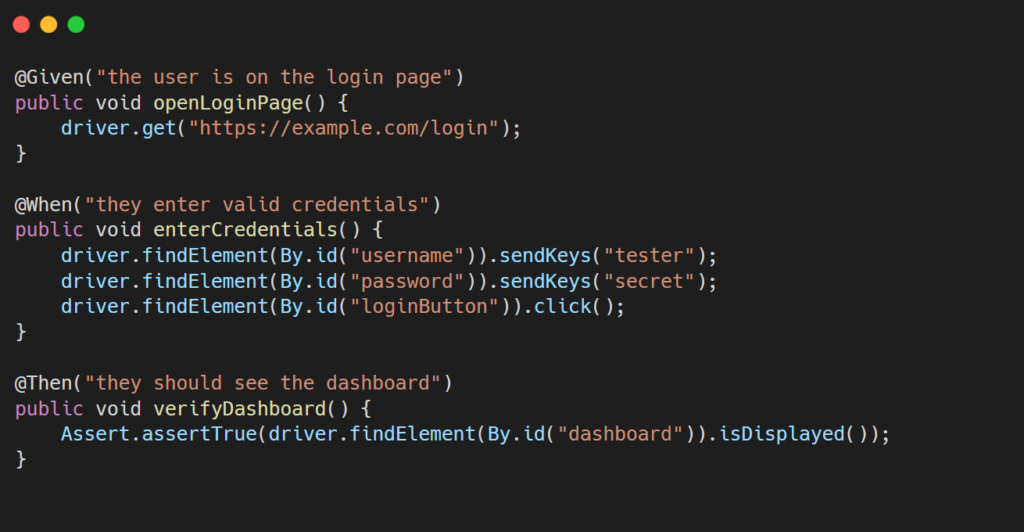
After scenarios are written, the next step is automation. Developers and testers use tools like Cucumber, SpecFlow, or Behave to translate the Gherkin scenarios into executable tests. Each scenario becomes an automated test that can be run repeatedly. Automation ensures that the expected behavior is continuously validated as the software evolves. This step also reduces manual testing effort and provides fast feedback on regressions.
4. Execution
Finally, the automated scenarios are integrated into the CI/CD pipeline, where they run continuously alongside other tests. Teams receive immediate feedback if a scenario fails, allowing issues to be addressed quickly. Scenarios act as both a quality check and a living documentation of the system’s behavior. Over time, the automated BDD tests build a safety net that supports faster releases and confident changes.
By following this cycle — Discovery → Formulation → Automation → Execution — BDD ensures that the team is aligned, requirements are clear, and software behavior is validated early and continuously. It’s this combination of collaboration, clarity, and automation that makes BDD a powerful approach in modern development.
Choosing the right BDD framework
Development teams in 2025 face a crucial choice when picking the right behavior driven development framework. If you’re asking what does BDD stand for testing, it refers to a collaborative approach that emphasizes shared understanding of system behavior through clear, testable scenarios. The best fit depends on your team’s programming expertise, current toolset, and project needs.
Cucumber vs SpecFlow: Language and ecosystem fit
Cucumber stands out as the most adaptable BDD framework. It supports Java, Ruby, JavaScript, Python, PHP, Perl, Swift, .NET, and C++. Recent data shows that more than 30% of BDD practitioners choose Cucumber. Its popularity comes from smooth integration with common test runners and automation tools.
Example – Cucumber (Java, Selenium)
Feature file (login.feature):
Step definitions (Java + Selenium):
SpecFlow targets .NET environments exclusively, and its adoption has grown 25% among Agile teams. The framework works exceptionally well with Visual Studio and Azure DevOps. Teams already using Microsoft technologies find it a perfect match.
Behave for Python teams
Python teams looking for behavior driven development testing solutions should check out Behave. This framework uses Gherkin syntax like Cucumber but fits Python environments perfectly. Behave combines smoothly with Python’s testing ecosystem and offers easy-to-use command-line tools for test execution.
Behave embraces Python’s clean and readable approach. You start by creating a “features” directory with “.feature” files in Gherkin, matched with Python step definitions.
JBehave and Concordion for Java-based systems
Java teams have two solid options. JBehave attracts about 20 % of users who want narrative-style testing. Teams appreciate its natural language scenarios that fit well with agile methods.
Concordion takes a different path by letting you write test specs in HTML format. This approach brings together executable specs and complete documentation. Complex systems that need detailed coverage benefit greatly from this setup.
Tooling limitations and compatibility concerns
BDD frameworks have come a long way, evolving to address automation, readability, and collaboration. Still, a persistent challenge in the industry remains: unclear or poorly managed requirements continue to drive project failures. Industry studies highlight the severity of this issue – some estimate that up to 71 % of project failures (Infotech Research, 2005) can be traced back to problematic requirements, and broader research suggests that as much as 60–80 % of failures are linked to requirements mismanagement.
Key limitations include:
- Learning curves for teams new to BDD
- Teams need stakeholders available to validate scenarios
- Feature files become harder to maintain as projects grow
- Legacy systems and specialized tech can be tough to integrate
Teams can reduce these challenges by defining clear completion criteria for each feature. Research shows that early test automation cuts defect rates by up to 50 %.
Best practices for scalable BDD implementation
Behavior driven development at scale demands disciplined practices that work as your project grows. Your team should adopt these practices early to avoid technical debt and create sustainable test automation.
Start early with scenario writing
Teams that create scenarios during early development stages understand software behavior better. This approach helps spot problems before coding begins and saves time during later phases. Clear expectations emerge naturally when stakeholders review scenarios before implementation.
One behavior per scenario rule
Each scenario must test just one behavior. This makes scenarios simple to understand, automate, and maintain. The rule creates modular tests that teams can verify independently. Failed BDD tests quickly reveal the exact broken behavior in focused scenarios.
Use Background and Scenario Outlines effectively
The Background feature elegantly handles steps that repeat across multiple scenarios. It sets up common preconditions before every scenario without cluttering individual tests. Scenario Outlines let teams feed different data sets at the scenario level. This cuts down redundancy when you test the same behavior with multiple inputs.
Reuse step definitions across features
Smart reuse of step definitions in scenarios of all types improves maintainability. Changes in implementation details need updates in just one place. Step definitions must use consistent language – small differences like “Click” versus “click” prevent reuse.
Write declarative, user-focused scenarios
Your scenarios should mirror how users describe the behavior of the system instead of UI implementation details. Declarative scenarios emphasize what the software system should do rather than how it works. Tests become more resilient to UI changes while staying business-relevant. Declarative scenarios serve as better living documentation that clearly communicates business rules to everyone involved.
FAQs: Frequently asked questions about the behavior driven development
What is Behavior Driven Development (BDD) and how does it differ from traditional software development processes?
How does the BDD lifecycle work?
What are some popular BDD frameworks available in 2025?
What are some best practices for implementing BDD at scale?
What challenges might teams face when adopting BDD?
Making BDD work for your team
Behavior Driven Development is more than a testing technique – it’s a way of aligning business and technology through shared understanding. By turning requirements into clear, executable scenarios, BDD reduces misunderstandings and ensures software behavior matches user needs.
Successful adoption isn’t just about writing Given–When–Then; it requires active stakeholder involvement, good scenario design, and disciplined maintenance. When applied well, BDD strengthens collaboration, improves communication, and creates a safety net of automated checks that evolve with the codebase.
In today’s fast-paced environment, BDD helps teams move quickly without losing quality – delivering software that truly reflects business goals.


